A short story of VIRTUE: from virtual university to global marine learning community
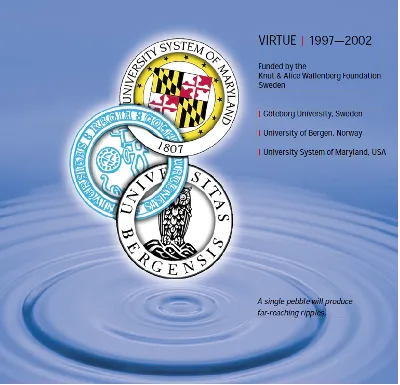
When VIRTUE (Virtual University Education) began in 1997, it was an ambitious idea ahead of its time: could universities in different countries use emerging digital tools to build a shared virtual learning environment? This question united researchers and educators from the University of Maryland Biotechnology Institute UMBI (USA), the University of Bergen (Norway), and the University of Gothenburg (Sweden), marking the beginning of a journey that would eventually reach classrooms, laboratories and marine areas around the world.

Initially supported by the Knut and Alice Wallenberg Foundation, VIRTUE started as a combined research and educational project. The research phase concluded in 2002, but the educational activities continued to grow, lead by the University of Gothenburg and Maryland Sea Grant College. Over the years, VIRTUE evolved from a virtual university experiment into a vibrant platform where students, teachers, and researchers collaborate on biodiversity, ecology, and environmental science.
VIRTUE as a bridge between academic research and scientific communication
Between 2011 and 2016, VIRTUE was run by the Faculty of Science at the University of Gothenburg, in partnership with the Maritime Museum Aquarium in Gothenburg. In 2016, leadership transitioned to the University’s Department of Biology and Environmental Sciences, reinforcing VIRTUE’s role as a bridge between academic research, science communication, and hands-on learning.

A turning point came in 2014, when VIRTUE received financial support from Formas to encourage collaboration between researchers and high-school students on marine biodiversity. That same year, the Hasselblad Foundation also contributed to expand the project internationally and include resources for freshwater environments. These investments laid the groundwork for VIRTUE-s, VIRTUE’s first major international expansion.
VIRTUE expands its boundaries
In 2017, VIRTUE-s was awarded 300,000 euros from the EU’s Erasmus+ programme to develop stronger educational tools and collaborations with partners in Spain, Germany, the USA, and Sweden. The project was completed in 2020, marking a successful phase of innovation and cross-border cooperation. Around the same time, additional support from the Hasselblad Foundation and Sydvatten AB enabled the development of enhanced tools for identifying and reporting freshwater species.
Since 2021, the Gothenburg Marine Biology Laboratory has served as the principal coordinator of VIRTUE, working closely with the Department of Biology and Environmental Sciences. This transition marked the beginning of a new phase, focused on strengthening digital platforms, supporting citizen science, and encouraging interdisciplinary education.
As of November 2025, VIRTUE includes participants from 57 countries—a remarkable milestone for a project that began as an experiment in virtual education. Today, teachers, students, researchers, and science communicators use the VIRTUE methodology to explore biodiversity, share discoveries, and build meaningful connections that cross oceans and cultures.
VIRTUE and BiodivOcean
BiodivOcean was created with the aim of expanding and strengthening the already established connections by VIRTUE, and introducing it to new countries (Norway, for instance). The project brings VIRTUE’s long tradition of collaboration into a renewed, future-focused framework, connecting classrooms, scientists, and communities to better understand and protect the ocean.