
Background on Microplastics
What is plastic?
Commercial plastics are made of polymers. The word polymer actually means “many parts” (poly = many, mer is derived from the Greek word meros meaning parts)
These polymers themselves are usually made from oil- or natural gas-based raw materials. They go through a process called polymerization to form the polymers or larger molecules which are built from repeating chains of monomers. One of the characteristics of plastics is that they are really durable and stick around for awhile. This relates to how they move through the environment, where they end up, and some of their characteristics within the environment.
Monomers and polymers
Monomers are small molecules which may be joined to form more complex molecules called Polymers.
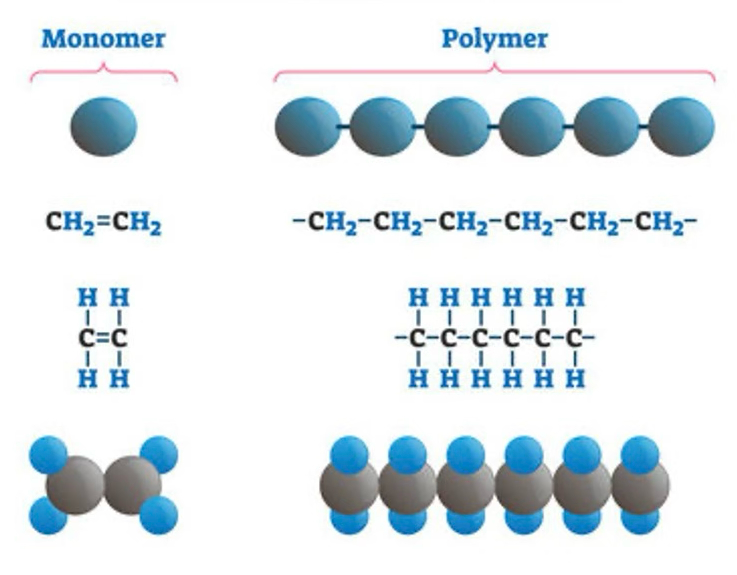
https://everydayrecycler.com/what-is-plastic/
Plastics have been around for just over a hundred years. We have seen an increase in plastic deposition mostly beginning around 1945, but over the past 40 years or so, global plastic production has quadrupled (Geyer et al. 2017). And specifically so has our reliance on single-use plastics, a major contributor to microplastics in the environment.
Single-use plastics are plastics that are intended to be used once and then thrown away. Some likely sound familiar like polystyrene or polypropylene or the various forms of polyethylene.
|
Imatge

|
Imatge

|
Imatge

|
Imatge

|
Imatge

|
Imatge

|
| Polyethylene terephthalate (PET) Water bottles, dispensing containers, biscuit trays |
High–density polyethylene (HDPE) Shampoo bottles, milk bottles, freezer bags, ice cream containers |
Low–density polyethylene (LDPE) Bags, trays, containers, food packaging film |
Polypropylene (PP) Potato chip bags, microwave dishes, ice cream tubs, bottle caps |
Polystyrene (PS) Cutlery, plates, cups |
Expanded polystyrene (EPS) Protective packaging, hot drink cups |
https://www.unenvironment.org/interactive/beat-plastic-pollution/
What are microplastics?
The definition actually means that the plastics are smaller than 5 mm in size which is about the size of a pencil eraser. Even though microplastics are so small, studies have shown that they are the major components of plastic pollution in the environment.
Microplastics have been found all around the world- from the tops of the Pyrenees mountains (Negrete Velasco et al., 2020) to the bottom of the Mariana trench in the Pacific Ocean (Jamieson et al., 2019).
This isn’t surprising since microplastics have been found to be released from virtually all of the plastic products that we use every day. This includes our food containers, baby bottles, and coffee mugs, as well as plastic particles shed from our car tires as we drive on roadways.
Due to their small size, microplastics can be ingested by organisms and then can make their way up the food chain (Setälä et al., 2014). In fact, one study found microplastics in 85% of fish tested (Wang et al., 2021). They are found in other organisms as well, including some seafood that we eat such as oysters, mussels, and clams.
Microplastics can also:
- Contain complex mixtures of harmful contaminants some
- Be ingested and digested by animals and incorporated into habitats
- Be a cause for concern of hazardous chemicals in humans
What can we do about microplastics?
Single-use plastics are a major contributor to microplastics. It makes no sense to use a material that is manufactured and designed to be used for single-use purposes and causes so many problems. As humans, we have existed without single-use plastics for most of our history. Today, half of all plastic produced is intended for single-use purposes. We know that single-use plastic contributes to making microplastics. We can start to address the microplastics problem by eliminating single-use plastics.
Back to Teaching Resources


